Marketing Automation: What the Set-Up Covers vs Ongoing Care (and What Each Costs)
 By Aniket Gupta, digital marketer & SEO expert
7 min read
Written from my own client work since 2019. Prices are my published prices; every other figure is linked to its source at the end.
Key takeaways
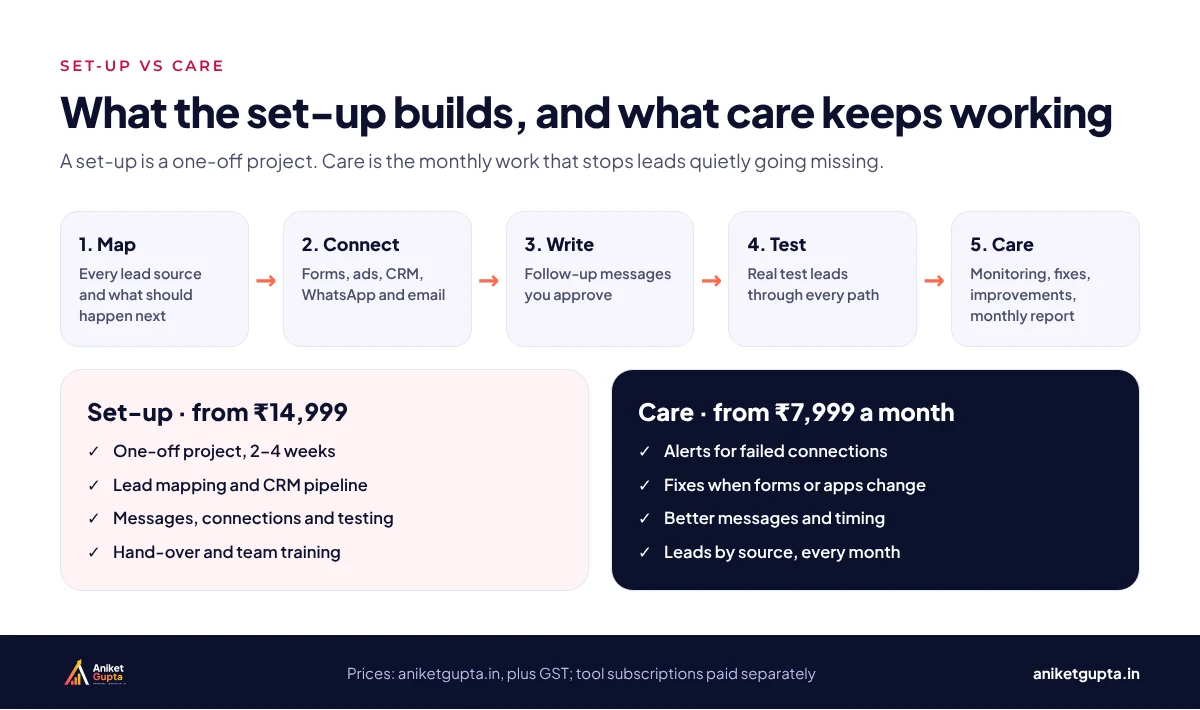
- A set-up is a one-off project: mapping your leads, connecting tools, writing messages and testing every path.
- Ongoing care is monthly: monitoring, fixing broken connections, improving messages and reporting on leads by source.
- Speed pays. A 2011 US study in Harvard Business Review found firms that contacted leads within an hour were nearly 7 times as likely to qualify them, yet only 37% of 2,241 companies replied that fast.
- WhatsApp Business Platform charges per message; since 1 October 2026 only the first 1,000 service replies a month are free, and utility and marketing templates are charged.
- My prices: a single workflow set-up starts at ₹14,999; care plans start at ₹7,999 a month, plus GST. Tool subscriptions are separate.
In this guide
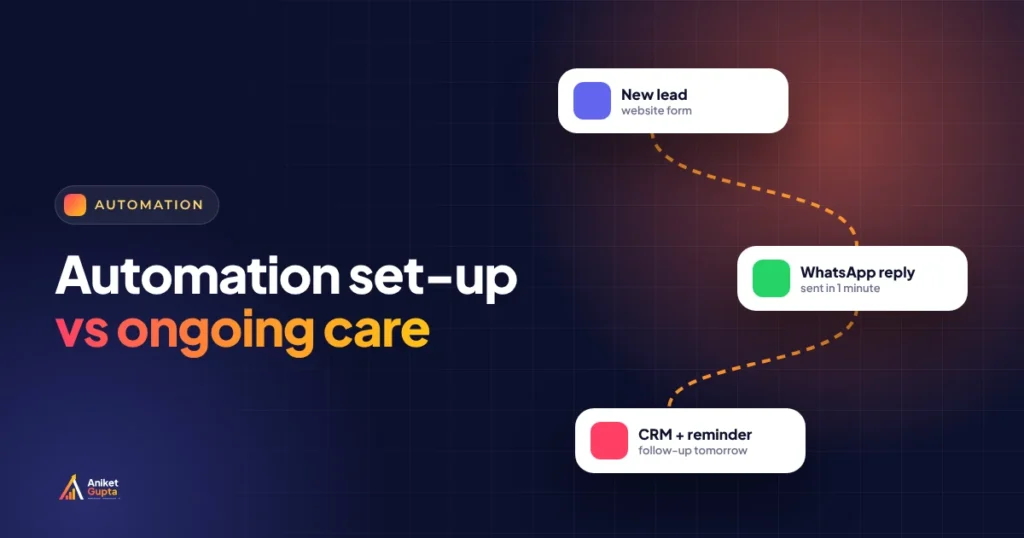
Automation sounds like something you set up once and forget. In practice, forms change, apps update, connections expire and messages go stale. Here’s the difference between building an automation and keeping it working, what each costs, and the research on why speed matters so much.
Why automation is worth it
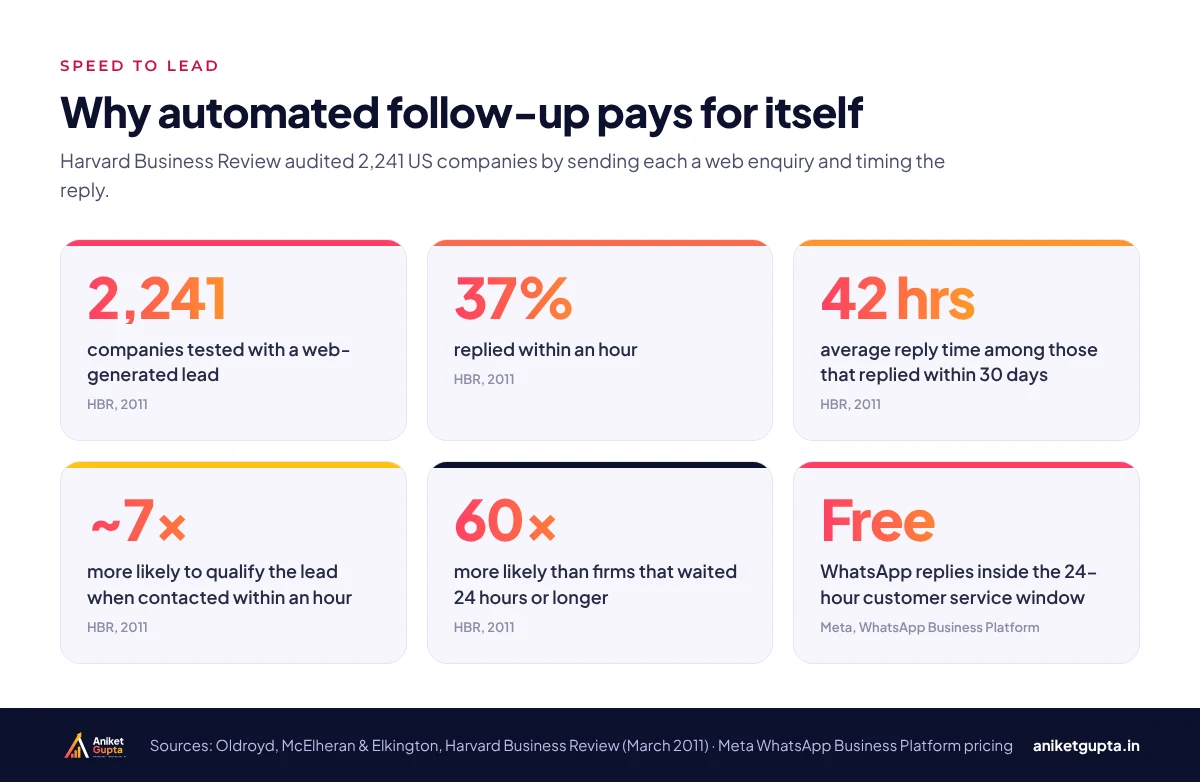
In a study published in Harvard Business Review, researchers sent web enquiries to 2,241 US companies and timed the replies. Only 37% responded within an hour, and the average response time among companies that replied within 30 days was 42 hours. Firms that contacted the lead within an hour were nearly seven times as likely to qualify it as those that waited even an hour longer, and more than 60 times as likely as those that waited a day or more.
The study is from 2011 and US-based, but the lesson still holds: replying fast makes a lead much easier to qualify, even if no study proves the first business to reply always wins the sale. Automation makes sure every enquiry gets an instant acknowledgement and your team gets an alert, even at 9 pm on a Sunday.
Set-up vs care at a glance
| Set-up | Ongoing care | |
|---|---|---|
| Type | One-off project | Monthly |
| Covers | Lead mapping, tool connections, messages, testing | Monitoring, fixes, improvements, reporting |
| Starting price (mine) | From ₹14,999 for one workflow | From ₹7,999 a month |
| Typical timeline | 2 to 4 weeks | Ongoing |
| You get | A working system and handover | A system that keeps working, and a monthly report |
What the tools cost: a simple CRM such as Bigin by Zoho costs ₹0 on the free edition and ₹400–₹1,080 per user a month on paid editions, billed yearly (Zoho, 2026). WhatsApp messages are charged per message by Meta, plus your provider’s monthly fee; marketing and utility templates are charged, and replies inside the 24-hour customer service window are free only up to 1,000 a month per number. I list every tool and its running cost in the quote, so you see the full monthly figure before anything is set up.
What the set-up includes
- Mapping every lead source: website forms, ads, WhatsApp, calls, directories.
- Setting up or cleaning your CRM with clear pipeline stages.
- Writing follow-up messages for WhatsApp and email, with your approval.
- Connecting the tools and testing every path with real test leads.
- Alerts so your team knows about new leads within minutes.
- A handover session and short notes for your team.
A sample set-up timeline
| Week | What happens |
|---|---|
| Week 1 | Lead sources and follow-up steps mapped and agreed |
| Week 2 | CRM, forms, WhatsApp and email connected |
| Week 3 | Test leads run through every path, then switched on |
| Week 4 | Response times and leads by source reviewed; first improvements |
What ongoing care covers
- Monitoring for failed connections and missed leads, with alerts.
- Fixes when a form, app or connection changes.
- Improvements to messages and timing based on replies.
- New workflows as your business adds services or channels.
- A monthly report of leads by source and response times.
How WhatsApp pricing works
Most businesses here want WhatsApp in their follow-up. On the official WhatsApp Business Platform, Meta switched to per-message pricing on 1 July 2025 and changed how service and utility messages are charged on 1 October 2026. According to Meta’s developer documentation, checked in November 2026:
| Message type | When it’s charged |
|---|---|
| Service (free-form replies) | Inside an open customer service window: first 1,000 a month free per business number, then charged (from 1 October 2026) |
| Utility templates (e.g. booking confirmations) | Charged, including inside the customer service window (from 1 October 2026) |
| Authentication templates (e.g. one-time codes) | Charged per message |
| Marketing templates (offers, reminders) | Always charged |
| Click-to-WhatsApp ad replies | Free during the free entry point window that opens when you reply within 24 hours |
In practice, replies to people who message you are free up to the monthly service allowance, while broadcast offers and order updates cost money per message. Utility and authentication rates also have volume tiers. I include expected WhatsApp costs in every quote. See WhatsApp marketing.
Tool costs to budget for
| Tool | Examples | Paid to |
|---|---|---|
| CRM | Zoho CRM, HubSpot | The CRM provider |
| Email platform | Brevo, Mailchimp | The email provider |
| Automation connector | Zapier, Make | The connector provider |
| WhatsApp messages | Through a provider dashboard | Meta, usually via the provider |
Do you need both?
If you have a few simple workflows and someone on your team can check them each week, a set-up with a good handover may be enough. If leads come from several sources, you run ads, or the automation messages customers directly on WhatsApp, ongoing care usually pays for itself the first time something breaks quietly. See marketing automation, email marketing and AI automation.
Five workflows worth automating first
| Workflow | What happens automatically | Why it matters |
|---|---|---|
| Instant enquiry reply | A WhatsApp or email acknowledgement within a minute, with what happens next | The lead knows you’ve seen it, and is less likely to call a competitor |
| Team alert | The right person gets the lead’s details on WhatsApp or email | Nobody has to watch an inbox |
| Missed-call follow-up | A WhatsApp message to callers you couldn’t answer | Calls are often the highest-intent leads |
| Appointment reminders | Reminders the day before and an hour before | Fewer no-shows |
| Review request | A short message with your Google review link after a job is done | A steady flow of fresh reviews for local SEO |
The review request connects automation to local SEO: Google says reviews and ratings help a business stand out, and my Google Business Profile checklist explains why a steady flow of recent reviews matters.
Common automation mistakes
- Messaging people who didn’t opt in. WhatsApp requires opt-in, and it damages trust.
- Automating a broken process. Agree how leads should be handled first, then automate it.
- No human handover. Every automated thread needs a clear point where a person takes over.
- Too many tools. Each connection is another thing that can break; keep the stack small.
- No monitoring. If nobody checks, a broken form can lose leads for weeks before anyone notices.
Losing leads that never hear back?
On a free consultation I’ll map where leads slip through today and what a simple follow-up system would cost, including tool costs.
Related guides
My take, from client work
Automate the first reply before anything else. A lead that hears back within minutes is far more likely to become a customer, and an instant WhatsApp or email reply is the easiest step to set up. Longer sequences can wait until that first step works every time.
FAQs
How much does marketing automation cost in Delhi?
It depends on the number of workflows and tools. My set-ups start at ₹14,999 for one workflow and care plans at ₹7,999 a month, plus GST and your tool subscriptions.
How fast should I reply to a new lead?
As fast as possible. The Harvard Business Review study found firms that replied within an hour were nearly seven times as likely to qualify the lead.
Are WhatsApp messages free?
Partly. Since 1 October 2026, each business number gets 1,000 free service replies a month inside open customer service windows; after that they’re charged. Marketing, utility and authentication templates are charged, except during a click-to-WhatsApp free entry point window.
Can I set up automation myself?
Simple ones, yes. Tools like Zapier and most CRMs have templates. Help is worth it when several tools and teams are involved.
What happens if an automation breaks?
Without monitoring, often nothing visible: leads simply stop arriving. Care plans include alerts and fixes.
Is WhatsApp automation allowed?
Yes, on the official WhatsApp Business Platform with customers who opted in and approved message templates.
Do I need a CRM?
Not always. A CRM helps once leads come from several sources or more than one person follows up. Simple automation can run from an email platform’s list or a well-structured Google Sheet.
How long does a set-up take?
Usually two to four weeks, including testing with real leads.