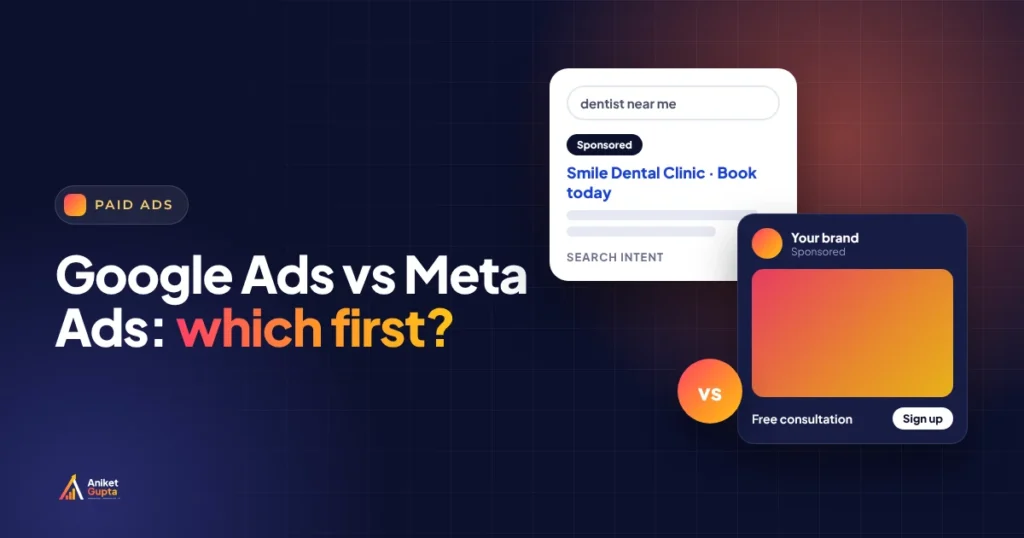
Google Ads vs Meta Ads for Lead Generation: Which Should You Start With?
 By Aniket Gupta, digital marketer & SEO expert
7 min read
Written from my own client work since 2019. Prices are my published prices; every other figure is linked to its source at the end.
Key takeaways
- Google Ads reaches people already searching for what you offer. Meta Ads reaches people who match your customer but aren’t searching yet.
- LocaliQ’s 2026 benchmarks put the average Google search cost per lead at $66.69; WordStream’s 2025 Facebook lead campaigns averaged $27.66. Both are US datasets, so compare the gap, not the dollars.
- The gap varies by industry: Facebook leads cost far less for legal and real estate, but slightly more for dentists and physicians.
- Google and Meta took 64% of the national ₹94,700 crore digital ad spend in 2025 (FICCI-EY).
- For most local service businesses, I start with Google search ads and add Meta once tracking and follow-up are working.
In this guide
If you have budget for one ad platform, which should it be? Google and Meta between them took 64% of the national digital ad spend in 2025, so for most businesses the choice really is between these two. The right answer depends on whether people already search for what you sell, how visual your offer is, and how quickly your team follows up.
The real difference: intent
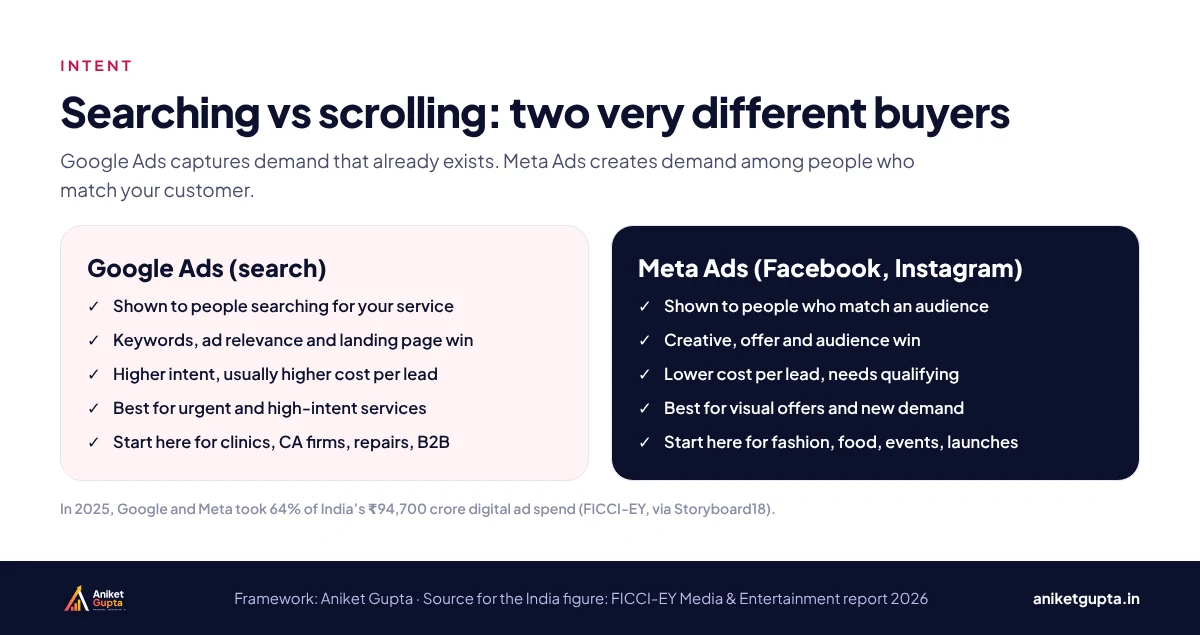
| Google Ads (search) | Meta Ads (Facebook and Instagram) | |
|---|---|---|
| Who sees the ad | People searching for your service | People who match an audience or interest |
| Buyer’s mindset | Ready to compare and contact | Browsing; needs to be interrupted |
| What wins | Keywords, ad relevance and landing page | Creative, offer and audience |
| Typical lead quality | Higher intent, usually higher cost | Lower cost, needs more qualifying |
| Good for | Urgent and high-intent services | Visual offers, events and new demand |
| Weak at | Products nobody searches for yet | Urgent needs that people search for |
What the benchmarks say
There’s no large published benchmark for local ad accounts, so the most useful datasets are US-based. Use them to compare the platforms with each other, not to predict your costs: rupee costs in Delhi are usually much lower.
- Google search ads (LocaliQ, 2026): average cost per click $5.42, click-through rate 6.64% and cost per lead $66.69. LocaliQ notes that cost per lead fell overall for the first time in five years.
- Facebook lead campaigns (WordStream, 2025): average cost per click $1.92, click-through rate 2.59%, conversion rate 7.72% and cost per lead $27.66, from 726 US campaigns between April 2024 and June 2025.
Cost per lead by industry
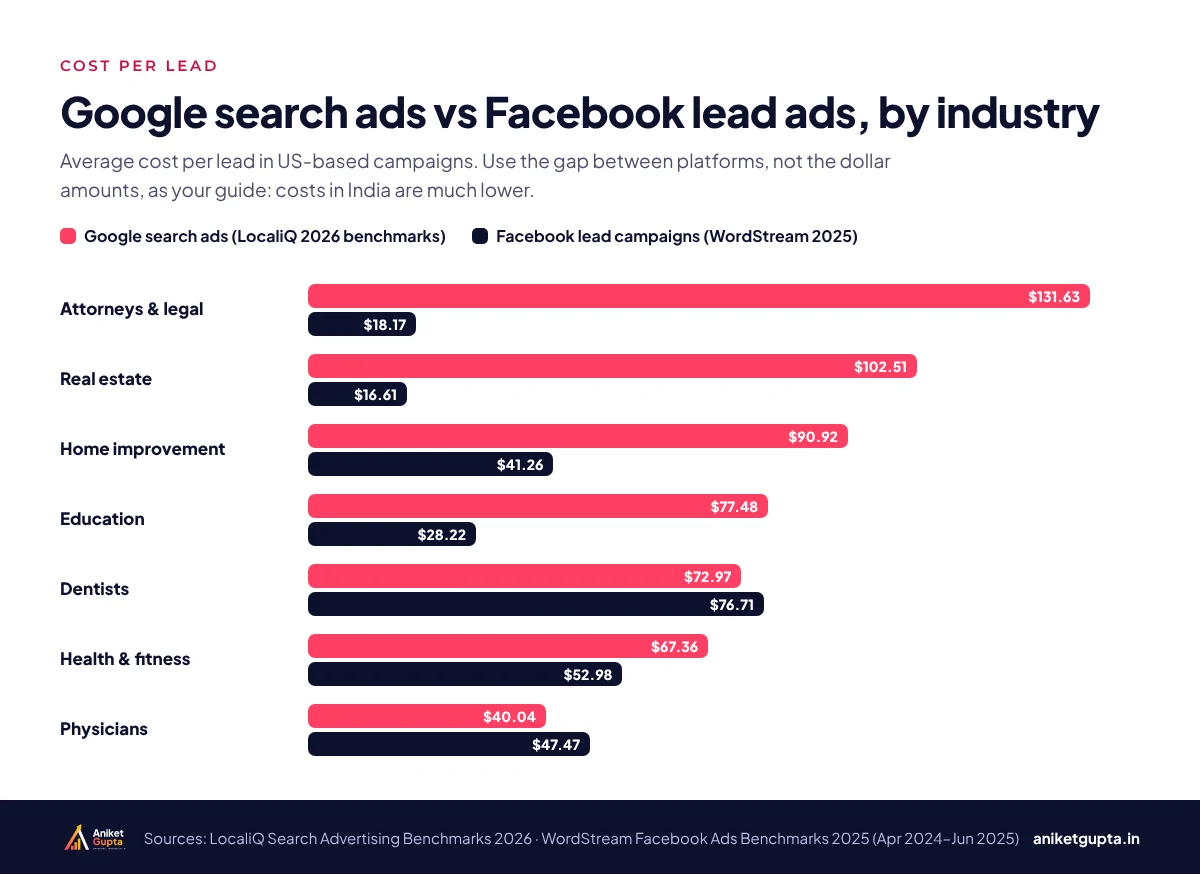
| Industry | Google search ads (2026) | Facebook lead ads (2025) | Lower in these datasets |
|---|---|---|---|
| Attorneys and legal | $131.63 | $18.17 | |
| Real estate | $102.51 | $16.61 | |
| Home and home improvement | $90.92 | $41.26 | |
| Education and instruction | $77.48 | $28.22 | |
| Dentists and dental services | $72.97 | $76.71 | |
| Health and fitness | $67.36 | $52.98 | |
| Physicians and surgeons | $40.04 | $47.47 |
Healthcare is the interesting case: for dentists and physicians, Google search leads were actually cheaper than Facebook leads in these datasets, because people search when they need care. For legal and real estate, Facebook leads were far cheaper, but those are also the industries where lead quality varies most.
Lead quality: why cheaper isn’t always better
A cost per lead says nothing about how many leads become customers. Meta lead forms are quick to submit, often pre-filled, which lowers the cost and the intent at the same time. Three things close the gap:
- Qualifying questions on Meta lead forms, such as budget, location or timeline.
- Fast follow-up. A Harvard Business Review study found firms that contacted leads within an hour were nearly seven times as likely to qualify them. See my guide to automation set-up vs ongoing care.
- Measuring cost per qualified lead or sale, not cost per form, using your own CRM or a simple sheet.
Which suits your business?
| Business | Start with | Why |
|---|---|---|
| Clinics, dentists, physiotherapists | Google search | People search when they need care |
| CA firms, lawyers, consultants | Google search | High intent, high value per client |
| Repairs and home services | Google search | Urgent, local searches |
| Coaching and education | Both | Search for courses; Meta for awareness and retargeting |
| Real estate launches | Meta | Visual, and creates demand |
| Fashion, food, D2C brands | Meta | Visual products people don’t search for by name |
| B2B services | Google search, then LinkedIn | Buyers search, then compare |
Splitting a small budget
With a small budget, splitting it evenly across platforms often means neither gets enough data to learn. Put most of it on the platform that fits your business best, set up call, form and WhatsApp tracking, and add the second platform once you can see which leads turn into customers. Meta is also a good second step for retargeting people who visited your site from Google. See how I run Google Ads and Meta Ads, or all paid ads services.
What to track from day one
- Calls from ads and from the website, as conversions.
- Form submissions as conversions, and WhatsApp clicks as micro-conversions (a click isn’t yet a conversation), in GA4 and the ad platform.
- The source of every lead in your CRM or sheet.
- Which leads became customers, so you can judge cost per sale.
Setting up each platform for leads
| Step | Google Ads | Meta Ads |
|---|---|---|
| Tracking | Calls, forms and WhatsApp clicks as conversions | Meta Pixel and Conversions API, plus lead form events |
| Targeting | Tight keyword groups by intent, plus negative keywords | Location, age and interests; broad audiences once tracking works |
| Ad | Headline that matches the search; call and location assets | Three to five creative angles; a clear offer in the first line |
| Destination | A landing page that matches the ad | An instant form with qualifying questions, or a landing page |
| Weekly review | Search terms report: add negatives, adjust bids | Creative and audience tests: cut weak ads |
Common mistakes on both platforms
- Launching without conversion tracking, so the platforms can’t learn and you can’t judge results.
- Sending ads to the home page instead of a page that matches the offer.
- Broad keywords with no negatives on Google, which spend budget on irrelevant searches.
- One creative on Meta, which leaves the algorithm nothing to test.
- Judging after three days. Both platforms need time and data to settle.
- Slow follow-up, which wastes the leads you’ve paid for.
Not sure where to start?
Share your goals and budget on a free consultation and I’ll tell you which platform to start with, what to test first and what a realistic test budget looks like.
Related guides
My take, from client work
With a small budget, don’t split it evenly. Put most of it where people already search for what you sell, which is usually Google, and use Meta to retarget visitors and test offers. Judge both on enquiries that become customers, not on cost per click.
FAQs
Are Facebook leads cheaper than Google leads?
In these US datasets, on average, yes. LocaliQ’s 2026 Google search benchmark is $66.69 per lead and WordStream’s 2025 Facebook lead campaigns averaged $27.66. They cover different years and campaigns, so treat them as a rough guide, not a controlled test. But for dentists and physicians, Google leads were cheaper in the same datasets.
Which is better for local businesses?
For services people search for, Google search ads usually work best first. Meta helps with offers, awareness and retargeting.
Are these benchmarks valid for Delhi?
They’re mostly US campaigns, so the dollar amounts don’t apply. The comparison between platforms and industries is still a useful guide.
How much should I spend on ads?
Enough for each campaign to get regular clicks and conversions. I agree a test budget with each client based on the cost per click in their market.
Why are my Meta leads poor quality?
Usually because the form is too easy to submit, the offer is vague or follow-up is slow. Qualifying questions and fast replies help.
Do I need a landing page for ads?
For Google Ads, almost always. Meta lead forms can work without one, but a landing page gives more control and better tracking.
Can I run both at once?
Yes, once tracking works. Google captures existing demand and Meta builds new demand and retargets visitors.
What about ChatGPT Ads?
They’re new here and best treated as a small, tracked test alongside Google and Meta.
Sources
- LocaliQ: Search Advertising Benchmarks 2026
- WordStream: Facebook Ads Benchmarks 2025 (726 US lead campaigns, April 2024 to June 2025)
- Storyboard18: Google and Meta hold two-thirds of India’s digital ad market (FICCI-EY report, March 2026)
- Harvard Business Review: The Short Life of Online Sales Leads (Oldroyd, McElheran and Elkington, March 2011)
- SmartCompany: Are you letting online leads go cold? (reporting the HBR study’s figures, July 2011)