Brand Identity Kit for Small Businesses: What It Should Include (and Why Consistency Pays)
 By Aniket Gupta, digital marketer & SEO expert
9 min read
Practical guidance from hands-on SEO, website and ads work for small businesses. Prices are my published rates; every other figure links to its source at the end.
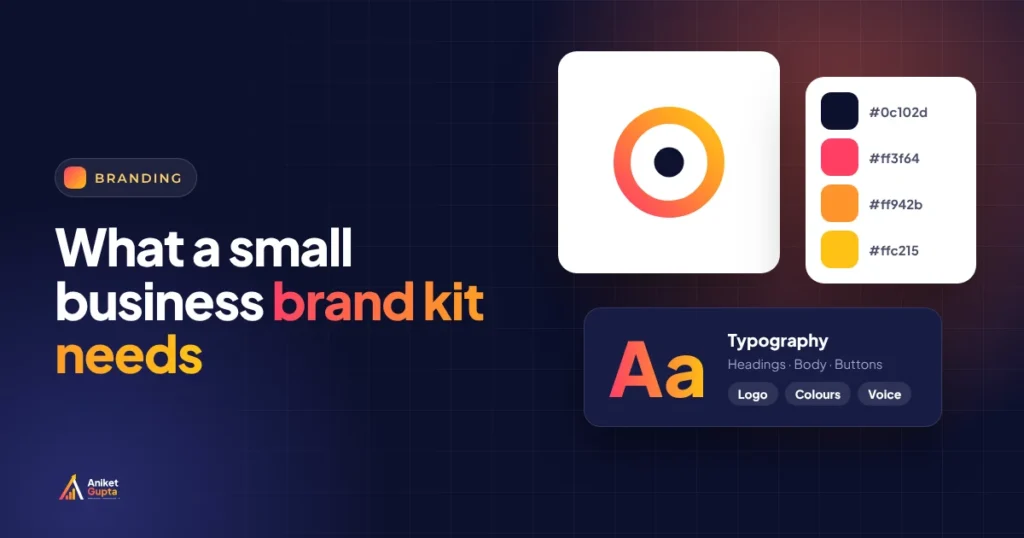
Line up your Instagram posts, visiting card, shop board and WhatsApp catalogue side by side. Do they look like they came from the same business? For most small businesses, they don’t, and customers notice even when they can’t say why. A business that looks inconsistent looks smaller, newer and riskier than it really is. This guide explains what a brand identity actually includes, the research on why consistency pays, exactly what a brand kit should contain, and how to build one in seven steps without a big-agency budget.
Key takeaways
- A logo is one part of your brand identity. The brand kit is the full system: logo versions, colours, fonts, imagery, tone of voice, templates and guidelines.
- Consistency matters: brand-software vendor Marq’s report links consistent presentation to revenue gains of 20% or more, a general finding rather than a promise for any one business.
- Trust drives buying: 81% of consumers say they must be able to trust a brand to buy from it (Edelman, 2019).
- Colour does a lot of the work: Singh (2006) found 62–90% of snap judgements about a product are based on colour alone.
- Start small: a logo suite, a palette, two fonts and a few templates will make everything look like it came from the same business.
Brand, logo and brand identity: what’s the difference?
| Term | What it is | Example |
|---|---|---|
| Brand | What people think and feel about your business | A clinic people trust for quick, accurate reports |
| Brand identity | The visual and verbal system you control | Logo, colours, fonts, photos, tone of voice |
| Logo | The mark that identifies the business | A symbol plus the business name |
| Brand kit | The files and rules that make the identity usable | Logo files, palette codes, fonts, templates, a guidelines PDF |
You can’t fully control your brand, because it lives in customers’ heads. You can control your brand identity, and a consistent identity is how you shape what people remember.
Why a consistent brand pays off
Read these numbers as background, not a forecast. They come from global surveys and studies of different ages (2006 to 2019) and from a brand-software vendor’s own report. They show why consistency matters in general; they can’t predict a revenue change for your business.
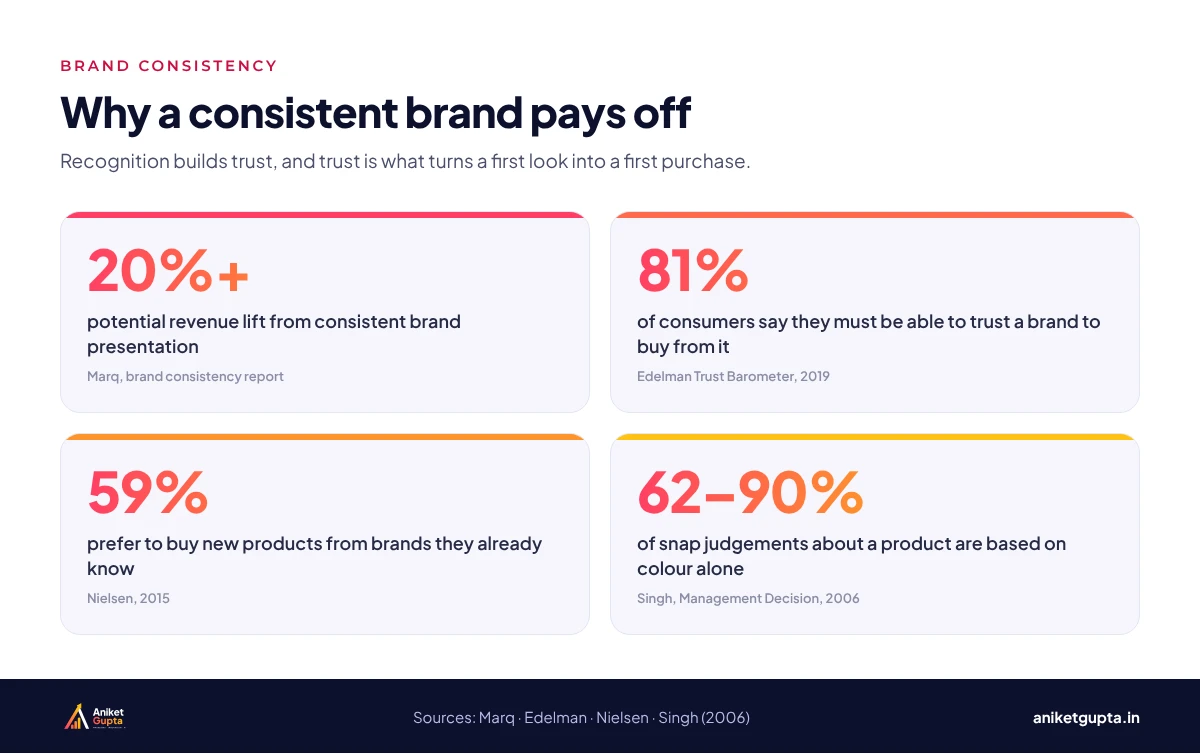
Marq’s brand consistency report links consistent brand presentation to revenue increases of more than 20%.
In Edelman’s 2019 report, 81% of consumers said trusting a brand to do what’s right is a deciding factor when they buy.
Nielsen’s 2013 global survey found 59% prefer to buy new products from brands they already know.
Singh’s 2006 study found people make up their minds within 90 seconds, and 62–90% of that is based on colour alone.
For a small business, consistency is what makes a modest marketing budget add up. Every post, flyer and ad reinforces the same memory instead of starting from scratch.
Every piece starts from zero
Each designer, printer and staff member guesses.
- Three shades of “brand blue”
- A blurry logo on the shop board
- A different font on every post
- Captions that sound like different businesses
Every piece builds the same memory
Anyone can create on-brand work in minutes.
- Exact colour codes for screen and print
- The right logo file for every use
- Templates for posts, stories and offers
- One recognisable voice everywhere
What a brand kit should include
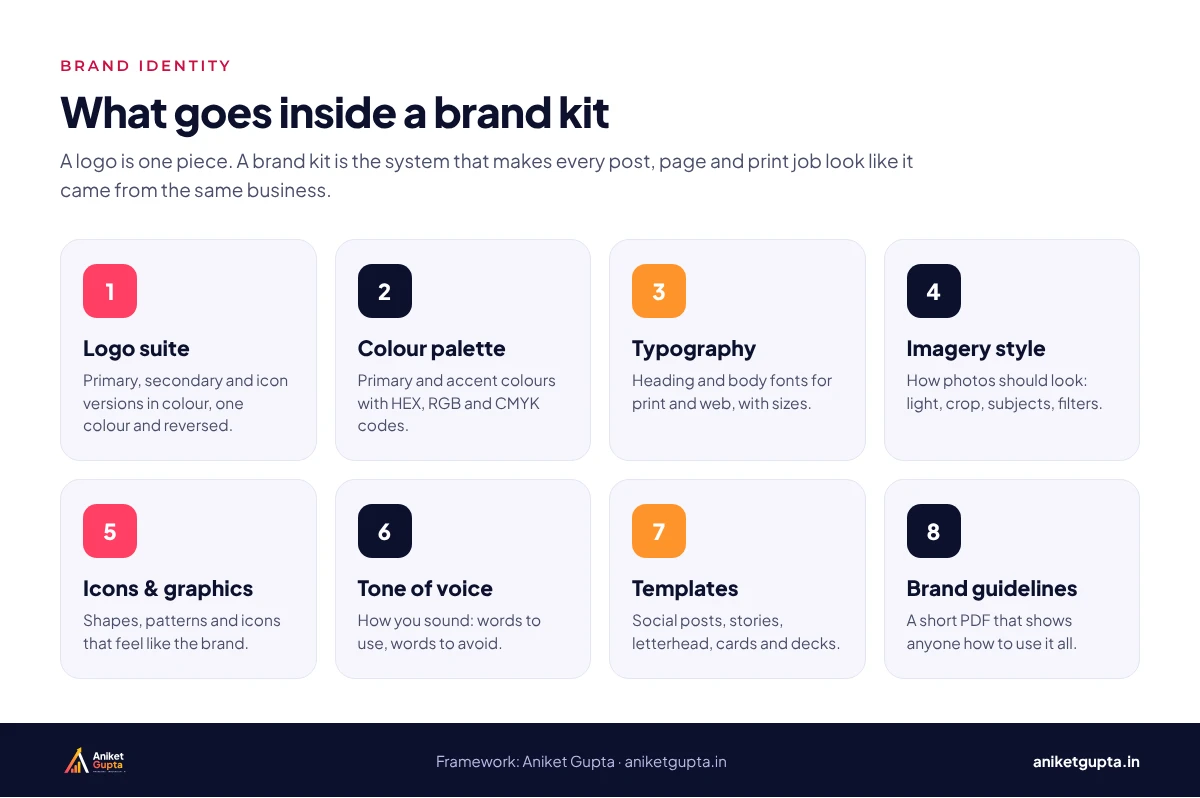
Logo suite
Your primary logo plus a horizontal or stacked version, an icon for small spaces like app icons and social profiles, and one-colour and reversed (white) versions for dark backgrounds.
Colour palette
Usually one or two primary colours, two or three accents and neutrals, each with HEX and RGB codes for screens and CMYK for print, so every designer and printer uses exactly the same shades. Check that text on your colours is readable: WCAG asks for a contrast ratio of at least 4.5:1 for normal text.
Typography
A heading font and a body font that work in print and on the web, with simple rules for sizes. Two fonts are enough for most businesses. If you serve customers in Hindi too, choose fonts with good Devanagari versions, such as those in the Noto or Mukta families on Google Fonts.
Imagery, icons and graphics
Guidance on photo style (natural light or studio, people or products), plus the shapes, patterns and icons that make your posts recognisable before anyone reads the name.
Tone of voice
How the business sounds: formal or friendly, technical or simple, with example phrases and words to avoid. This keeps captions, ads and WhatsApp replies consistent.
| Sounds like us | Doesn’t sound like us | |
|---|---|---|
| Greeting | “Hi Rahul, thanks for getting in touch.” | “Dear Sir/Madam, your query is noted.” |
| Offer | “20% off cleaning this week. Book a slot.” | “MEGA BLOCKBUSTER SALE!!! HURRY!!!” |
| Problem | “Sorry about the delay. Here’s what we’ll do.” | “Delay due to unavoidable circumstances.” |
Templates and guidelines
Ready-made templates for social posts, stories, visiting cards, letterheads and presentations, and a short guidelines PDF that shows anyone how to use the kit.
| Deliverable | Formats | Used for |
|---|---|---|
| Logo files | AI, SVG, PDF, PNG | Website, print, signage, social media |
| Colour codes | HEX, RGB, CMYK | Screens and printing |
| Fonts | Font files or Google Fonts links | Documents, website, design tools |
| Social templates | Canva or Figma files, PNG | Posts, stories, offers |
| Stationery | Print-ready PDF | Visiting cards, letterheads, envelopes |
| Brand guidelines | Briefing designers, printers and staff |
Brand kit checklist: what to ask your designer for
- Primary, secondary and icon versions of the logo.
- Colour, one-colour (black) and reversed (white) versions of each.
- Vector files (AI, SVG or PDF) for signage and print, not just JPG or PNG.
- HEX, RGB and CMYK codes for every brand colour.
- Font names, with licences or free Google Fonts alternatives.
- Editable templates for the posts and documents you make most often.
- A short guidelines PDF with do’s and don’ts.
- Full ownership and copyright of the final files once you’ve paid.
How to build your brand identity in 7 steps
- Define your positioning. Who you serve, what you offer and why people should choose you, in two sentences.
- Study competitors. Note the colours and styles your category uses, so you can stand apart.
- Choose a personality. Three to five words, such as “calm, precise and caring” for a diagnostic lab.
- Design the logo. Test it at app-icon size and on a large banner, in colour and in one colour.
- Build the system. Palette, fonts, imagery style and icons that support the logo.
- Create templates. The ten things you make most often, from Instagram posts to quotations.
- Write simple guidelines and roll out. Update your website, Google Business Profile, signage and social profiles together.
Roll out in one go. Changing your logo on Instagram but not on your Google Business Profile, website and shop board for months creates exactly the inconsistency the kit is meant to fix. Make a list of every place your brand appears and update them together.
Protect it: trademark your logo and name
Your logo and business name are assets. Registering them as trademarks gives you legal rights over their use in your category. In India, the government fee to file online is ₹4,500 per class for individuals, startups and small enterprises. I explain the costs and steps in logo design cost in Delhi.
Check before you fall in love with a design. Search the trademark registry for similar names and marks in your class before finalising a logo, so you don’t have to rebrand later.
When it’s time to rebrand
Square’s guide to rebranding lists signs that a business has outgrown its identity. The most common for small businesses:
- Your brand looks dated next to competitors.
- Customers can’t tell you apart from similar businesses.
- Your services, prices or target customers have changed.
- You’ve merged with or acquired another business.
- Customers don’t understand your value from your current look and messaging.
A good rebrand keeps what people already recognise, such as your name, a colour or a symbol, and modernises the rest. If you’re rebuilding your website at the same time, follow the website redesign SEO checklist so you don’t lose Google traffic.
Common branding mistakes
Colours and fonts are left to chance, so every piece looks different.
No vector files means blurry signage and costly redraws later.
What’s fashionable this year can look dated in two.
Five colours and four fonts read as no system at all.
Always get full rights and source files once you’ve paid.
Without a short PDF, the next designer or printer starts guessing.
What a brand identity costs
| Package | What’s included | Starting price (mine) |
|---|---|---|
| Logo design | Original concepts, refinement and every file format | ₹3,000 + GST |
| Brand identity kit | Logo suite, colours, fonts, templates and a guidelines PDF | ₹10,000 + GST |
| Monthly social creatives | 12 on-brand post designs a month (design only) | ₹6,000/month + GST |
| Brochure design | Content plan, layout and print-ready files | ₹2,500 + GST |
A brand kit pays off most when it’s used everywhere: your website, Google Business Profile photos, social posts and print. If you’re rebuilding your website too, read what makes a website generate leads.
Want a brand kit that’s ready to use?
I design logos and complete brand identity kits for small businesses in Delhi and beyond, with every file and full ownership included. Logos from ₹3,000 and brand kits from ₹10,000, plus GST.
Related guides
FAQs
What is the difference between a logo and a brand identity?
A logo is the mark that identifies your business. A brand identity is the whole visual and verbal system around it: colours, fonts, imagery, tone of voice and templates.
What should a brand kit include?
A logo suite, colour palette with HEX, RGB and CMYK codes, two fonts, imagery and icon guidance, tone of voice, templates and a short guidelines PDF.
Does a small business really need a brand kit?
Yes, even a simple one. It makes every post, sign and document look like it came from the same business, which builds recognition and trust.
How much does a brand identity kit cost?
It varies widely. My brand identity kits start at ₹10,000 plus GST and logos at ₹3,000 plus GST.
How long does it take to create a brand identity?
A logo usually takes one to two weeks and a full brand identity kit two to three weeks, depending on feedback rounds.
Which file formats should I get?
Vector files (AI, SVG or PDF) for print and signage, plus PNG for everyday use, and colour codes in HEX, RGB and CMYK.
Should I trademark my logo?
If the name and logo matter to your business, yes. In India the online filing fee is ₹4,500 per class for individuals, startups and small enterprises.
How often should a business rebrand?
Only when there’s a clear reason: a dated look, a changed offer, new customers or a merger. Many businesses refresh rather than fully rebrand.
Sources
- Marq: Brand governance (citing Marq’s brand consistency report)
- Edelman: 2019 Trust Barometer Special Report, In Brands We Trust?
- Next TV: Nielsen advice for new product success (2013 global survey)
- Singh, S. (2006). Impact of color on marketing. Management Decision
- Square: 7 things that signal it’s time to rebrand your business
- W3C: Understanding WCAG contrast (minimum)
- IP India: Trade marks fee schedule