Shopify vs WooCommerce for Delhi Businesses: Costs, Fees and Which to Choose
 By Aniket Gupta, digital marketer & SEO expert
7 min read
Written from my own client work since 2019. Prices are my published prices; every other figure is linked to its source at the end.
Key takeaways
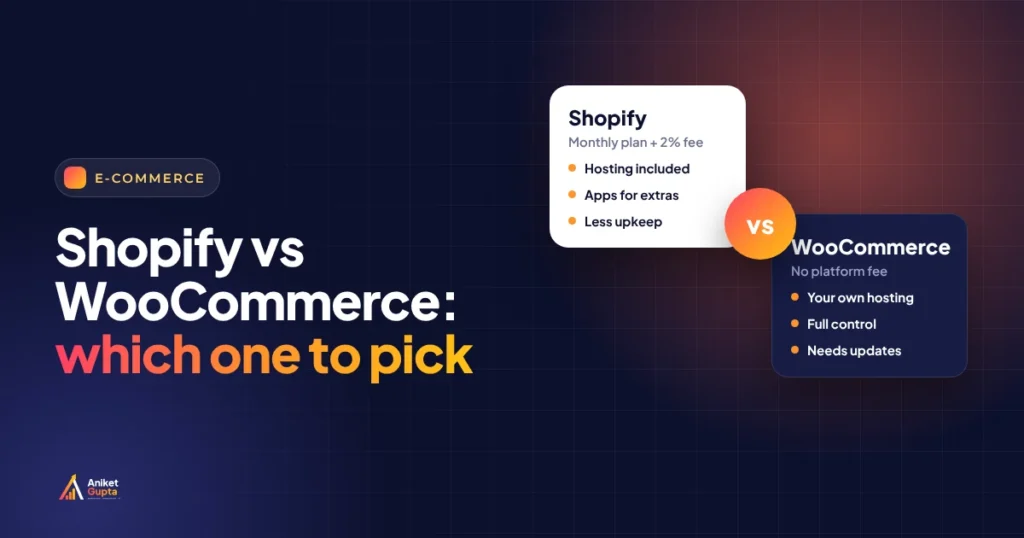
- Shopify is easier to run and maintain; WooCommerce gives more control and has no platform fee.
- Shopify’s Basic plan is ₹1,994 a month billed monthly or ₹1,499 billed yearly, with a 2% fee on sales through third-party gateways such as Razorpay (Shopify, November 2026).
- WooCommerce’s core plugin is free and adds no transaction fee; you pay for hosting, extensions and upkeep.
- On ₹2,00,000 a month in sales, Shopify Basic plus Razorpay comes to about ₹10,714 a month in plan and payment fees, against about ₹4,720 in gateway fees on WooCommerce, before hosting.
- Both rank well on Google. Category pages, product content and speed matter more than the platform.
In this guide
I build stores on both platforms, and the right choice depends far more on how you’ll run the store than on features. Both can take payments through Razorpay, handle GST invoices with the right set-up and rank on Google. The real differences are cost structure, maintenance and flexibility.
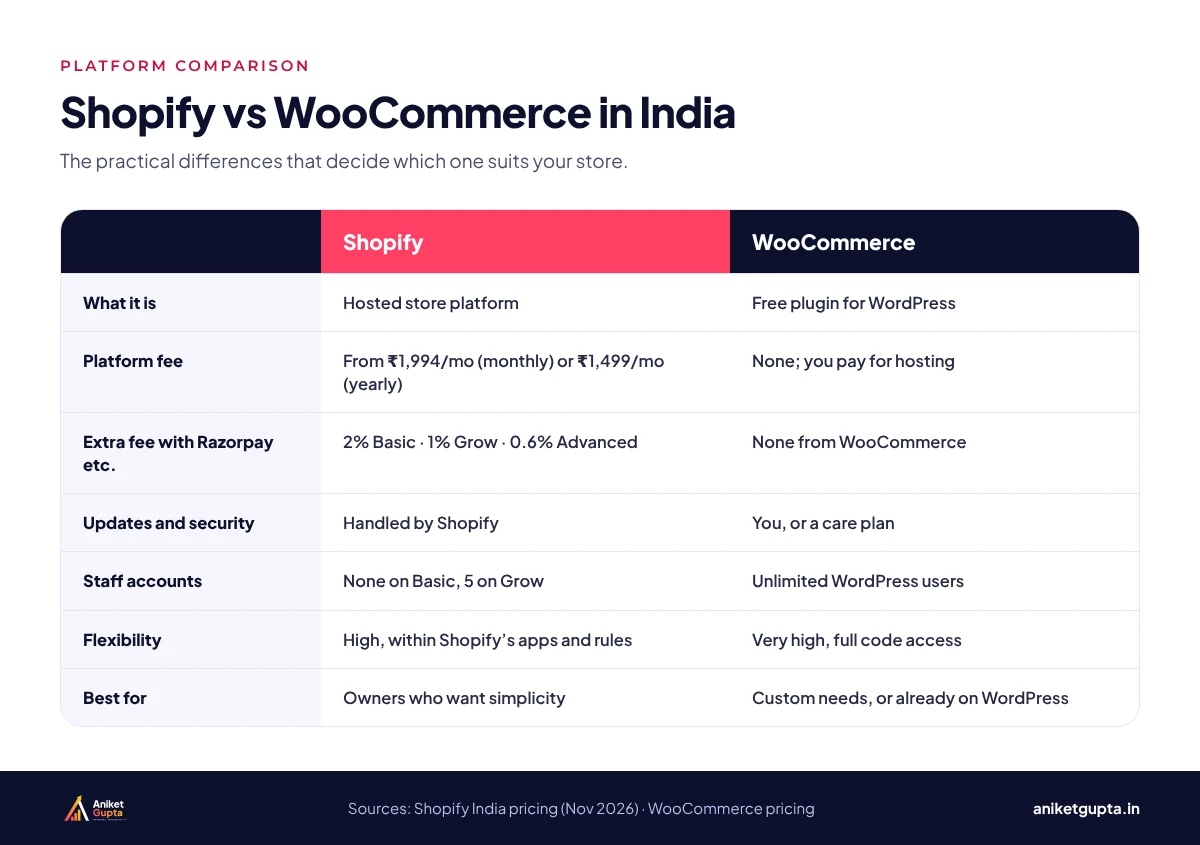
Quick comparison
| Shopify | WooCommerce | |
|---|---|---|
| What it is | Hosted store platform | Free plugin for WordPress |
| Monthly platform fee | From ₹1,994 billed monthly (₹1,499 billed yearly) | None; you pay for hosting |
| Extra fee with Razorpay or other gateways | 2% on Basic, 1% on Grow, 0.6% on Advanced | None from WooCommerce |
| Staff accounts | None on Basic, 5 on Grow, 15 on Advanced | As many WordPress users as you need |
| Updates and security | Handled by Shopify | Your responsibility, or a care plan |
| Flexibility | High, within Shopify’s apps and rules | Very high, with full code access |
| Best for | Most product stores that want simplicity | Stores needing custom features or already on WordPress |
Costs for a Delhi store
Shopify
| Plan | Billed monthly | Billed yearly | Third-party payment fee | Staff accounts |
|---|---|---|---|---|
| Basic | ₹1,994/month | ₹1,499/month | 2% | None |
| Grow | ₹7,447/month | ₹5,599/month | 1% | 5 |
| Advanced | ₹30,164/month | ₹22,680/month | 0.6% | 15 |
| Plus | From ₹1,75,000/month | Not listed | 0.2% | Unlimited |
Shopify’s pricing page lists third-party payment provider fees on every plan, and Shopify Payments isn’t offered here (India isn’t on its list of supported countries), so most Delhi stores use a gateway such as Razorpay. Shopify adds its own percentage on top of the gateway’s fee. The page also offers a three-day free trial, then ₹20 a month for three months on most plans. Paid apps can add to the monthly bill.
WooCommerce
WooCommerce describes its core plugin as free to download and use, with no revenue share and no additional fee for third-party payment providers. You pay for WordPress hosting, any paid extensions (WooCommerce lists them at $29 to $299 a year each) and the gateway fee. The trade-off is maintenance: someone has to keep WordPress, plugins and security up to date, which is why I recommend a maintenance plan for WooCommerce stores.
Payment gateway
Razorpay’s standard fee is 2% of domestic transactions (cards, UPI and netbanking) plus 18% GST on that fee, with no setup or annual maintenance charge under the standard plan. International cards are 3% plus GST. Check your own contract, since negotiated and promotional rates differ.
A worked example of fees
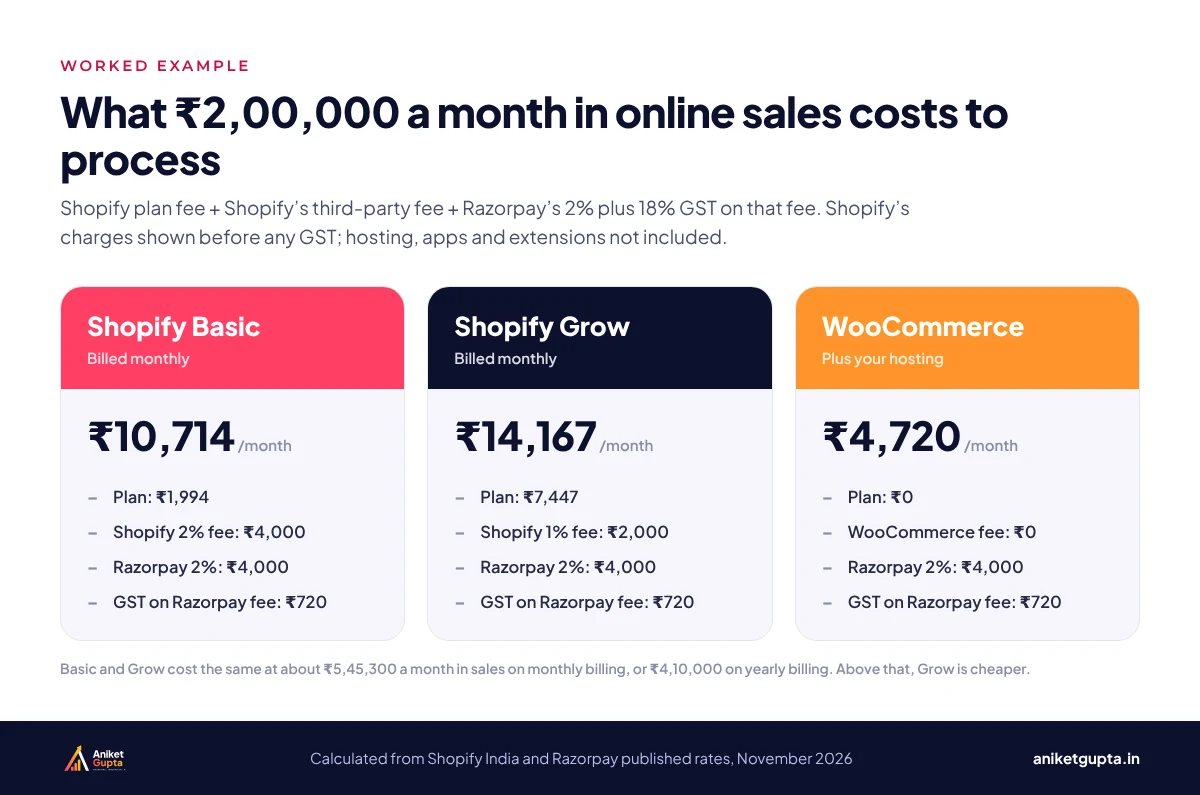
Here’s what ₹2,00,000 a month in online sales costs in plan and payment fees on each option, using the published rates above. Shopify’s charges are shown before any GST, and hosting, apps and extensions aren’t included.
GST on platform fees: Shopify adds 18% GST to its plan and fees for Indian businesses, which you can claim back as input tax credit if you give it your GSTIN (PayGlocal, July 2026). WooCommerce has no platform fee, so GST only applies to your hosting, paid extensions and Razorpay’s fee.
| Cost on ₹2,00,000 of sales | Shopify Basic (monthly) | Shopify Grow (monthly) | WooCommerce |
|---|---|---|---|
| Platform plan | ₹1,994 | ₹7,447 | ₹0 |
| Shopify third-party fee | ₹4,000 (2%) | ₹2,000 (1%) | ₹0 |
| Razorpay fee | ₹4,000 (2%) | ₹4,000 (2%) | ₹4,000 (2%) |
| GST on Razorpay fee (18%) | ₹720 | ₹720 | ₹720 |
| Total before hosting and apps | ₹10,714 | ₹14,167 | ₹4,720 |
Two things stand out. First, at this level of sales, Shopify Basic is cheaper than Grow. The two cost the same at about ₹5,45,300 a month in sales on monthly billing (₹4,10,000 on yearly billing); above that, Grow’s lower percentage fee wins. Second, the gap between Shopify and WooCommerce grows with your sales, but WooCommerce needs hosting and upkeep that Shopify includes, so compare the full monthly cost, not just fees.
Ease of use and maintenance
| Task | Shopify | WooCommerce |
|---|---|---|
| Adding products and managing orders | Simple, built in | Simple once set up |
| Hosting and speed | Included | Depends on your hosting |
| Security and updates | Handled by Shopify | Regular plugin and core updates needed |
| Custom features | Through apps or theme code | Through plugins or custom code |
| Team access | Limited staff accounts on lower plans | Flexible WordPress user roles |
SEO on each platform
Both platforms can rank well. Shopify uses fixed URL patterns such as /products/ and /collections/ and can create more than one URL for the same product, which it handles with canonical tags by default. WooCommerce gives you full control over URLs and structure, but also more ways to create duplicate or thin pages with filters and tags. In practice, category pages, product descriptions, internal links and speed matter far more than the platform. See e-commerce SEO and the Vapors Choice UAE case study, an online store where clicks grew 13% across two six-month periods.
How popular each one is
W3Techs’ November 2026 data shows WooCommerce on 7.8% of all websites (11.4% of sites with a known content management system) and Shopify on 5.3% (7.9%). Both have large communities of developers, themes and apps, including here in Delhi, so either is a safe long-term choice.
Which should you choose?
- Choose Shopify if you want to focus on selling, have a standard catalogue, and don’t want to manage hosting, updates or security.
- Choose WooCommerce if you already run WordPress, need custom features, want full control of your data and URLs, or want to avoid a platform fee on every sale.
- Either way, plan your categories, filters and product data before you build. That decides your SEO more than the platform.
Things Delhi stores need to plan for
- Cash on delivery. Both platforms support COD; decide whether to offer it and how to limit returns.
- GST invoices. Both can produce GST-compliant invoices with the right settings or app; set your GSTIN and tax rules before launch.
- Shipping. Courier aggregators integrate with both; check pin-code serviceability and COD limits.
- UPI. Razorpay and similar gateways support UPI on both platforms, which matters for mobile shoppers.
- Language and currency. Both support INR pricing; add Hindi or other languages only if your customers need them.
Moving between platforms later
You’re not locked in. Products, customers and orders can be moved between Shopify and WooCommerce with migration tools. The SEO risk is the same as any redesign: product and category URLs change, so every old URL needs a permanent redirect. My redesign SEO checklist covers the steps.
Want a straight recommendation?
Tell me what you sell, how many products you have and your expected monthly sales, and I’ll recommend a platform with a fixed quote.
Related guides
My take, from client work
Choose based on who will run the store day to day. If nobody on your team wants to handle updates, backups and plugin conflicts, Shopify’s monthly fee buys peace of mind. If you already have a WordPress site, a developer you trust and lots of content, WooCommerce usually makes more sense.
FAQs
Is Shopify or WooCommerce cheaper for a Delhi business?
WooCommerce usually has lower running costs because there’s no platform fee or third-party transaction fee, but you pay for hosting and maintenance. Shopify costs more each month but needs less upkeep.
Does Shopify charge a transaction fee?
Yes, when you use a third-party payment provider: 2% on Basic, 1% on Grow, 0.6% on Advanced and 0.2% on Plus, according to Shopify’s pricing page in November 2026. This is in addition to your gateway’s fee.
What does Shopify cost per month?
Basic is ₹1,994 a month billed monthly or ₹1,499 billed yearly; Grow is ₹7,447 or ₹5,599; Advanced is ₹30,164 or ₹22,680 (Shopify, November 2026).
Is WooCommerce really free?
The core plugin is free and charges no transaction fees. You pay for hosting, any paid extensions and your payment gateway.
Which is better for SEO?
Both can rank well. Content, category structure and speed matter more than the platform.
Can I move from WooCommerce to Shopify later?
Yes. Products, customers and orders can be migrated, and old URLs should be redirected to protect rankings.
Which payment gateways can a Delhi store use?
Razorpay, PayU, Cashfree and PhonePe are common choices on both platforms.
Which platform is easier for my team?
Shopify, for most teams, because hosting, security and updates are handled for you.
Sources
- Shopify India: Pricing (plans, staff accounts and third-party payment fees, November 2026)
- Razorpay: Payment gateway pricing explained (2026)
- WooCommerce: Pricing (free core, hosting and extension costs)
- W3Techs: Usage statistics of WooCommerce (November 2026)
- W3Techs: Usage statistics of Shopify (November 2026)