How to Show Up in AI Overviews, AI Mode and ChatGPT
 By Aniket Gupta, digital marketer & SEO expert
13 min read
Practical guidance from hands-on SEO, website and ads work for small businesses. Prices are my published rates; every other figure links to its source at the end.
Ask Google or ChatGPT for “the best physiotherapist in Preet Vihar” and you increasingly get a written answer that names a few businesses before any list of links. Getting named in those answers mostly comes down to things you control: pages Google can index and quote, a complete Google Business Profile with genuine reviews, and a website that states your services, prices and areas plainly. This guide explains how AI Overviews, AI Mode and ChatGPT decide what to show, what I found when I ran eight Delhi searches through Google AI Mode, which “AI SEO” tricks to skip, and a checklist you can work through in a month.
Key takeaways
- Google says there are no special requirements for AI Overviews or AI Mode. A page needs to be indexed and allowed to show a snippet. Good SEO is the work.
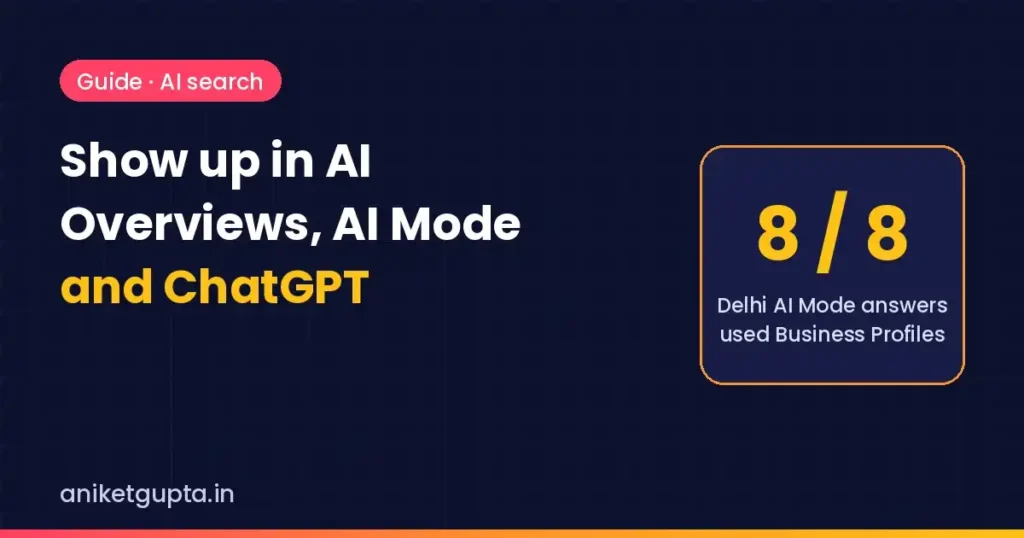
- For local searches, your Google Business Profile carries real weight. In my test of 8 Delhi searches in AI Mode, every answer showed rated Business Profiles and linked to the businesses’ own websites. None linked to Justdial.
- ChatGPT works differently. It uses OpenAI’s OAI-SearchBot and outside search data, and in BrightLocal’s study it leaned on Bing and Yelp. A Bing Places listing is worth setting up.
- AI answers take clicks: in Pew’s study people clicked a result on 8% of searches with an AI summary and 15% without one. Being named in the answer matters more than it used to.
- Skip the hacks. Google ignores llms.txt, needs no special schema and warns against fake mentions. Measure with Search Console’s generative AI report and Bing’s AI Performance report.
What changed: answers before links
Three kinds of AI answer now sit between your customers and your website:
- AI Overviews are summaries at the top of normal Google results. Google shows them when it decides they add something to the usual list of links.
- AI Mode is Google’s chat-style search, with its own tab, which handles follow-up questions. Google said in July 2026 that it had passed 1 billion monthly users.
- ChatGPT search looks things up on the web and cites its sources. OpenAI reported 900 million weekly users in February 2026, and Sam Altman said India alone had 100 million.
The cost is clicks. Pew Research tracked 900 US adults through March 2025: when a Google AI summary appeared they clicked a normal result on 8% of visits, against 15% when it didn’t, and clicked a link inside the summary on just 1%. Ahrefs found the top-ranking page earned 58% fewer clicks on searches with an AI Overview than expected, in a study of 300,000 keywords comparing December 2025 with December 2023.
For a local business the picture is less bleak. People still need a phone number, a location and a reason to trust you. If the answer names you, the call or the map tap often follows. If it doesn’t, you may never know the search happened, which is why it’s worth working on.
A few terms, in plain English
| Term | What it means |
|---|---|
| AI Overview | An AI summary at the top of normal Google results, with links to sources |
| AI Mode | Google’s conversational search that answers follow-up questions |
| Query fan-out | Google’s AI running several related searches behind the scenes to build one answer |
| Citation | A link or source shown inside an AI answer |
| GEO / AEO | “Generative” or “answer engine” optimisation. Google says this work is still SEO |
| OAI-SearchBot | OpenAI’s crawler that decides which sites can appear in ChatGPT search |
How Google and ChatGPT decide what to show
Google AI Overviews and AI Mode
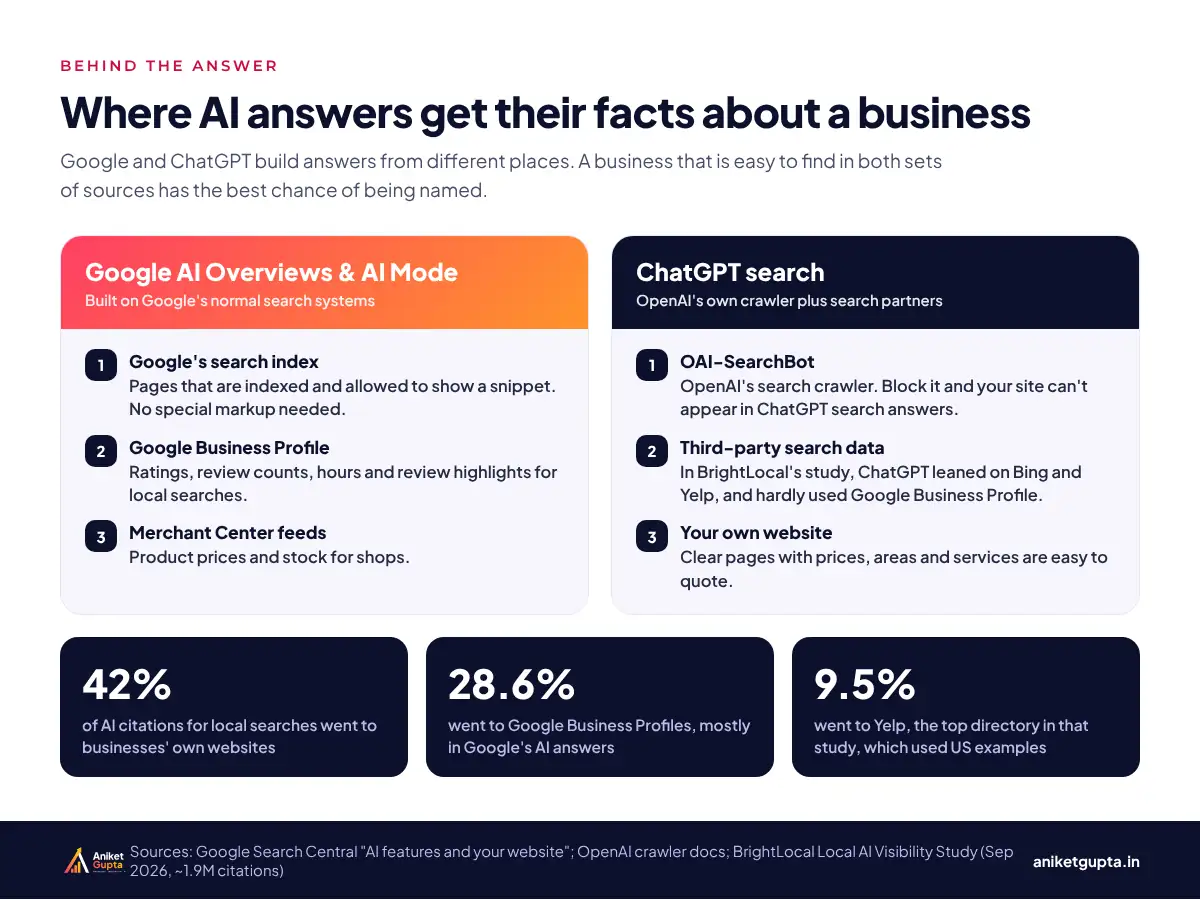
- Same rules as normal search. Google’s documentation says a page only needs to be indexed and eligible to show a snippet. “There are no additional technical requirements,” and no special schema.org markup.
- More pages get a chance. Both features can use “query fan-out”, running several related searches across subtopics. A page that answers one specific question well can be cited even if it doesn’t rank first for the main search.
- Profiles and feeds for businesses. Google’s July 2026 guide points local businesses to Google Business Profile and shops to Merchant Center feeds.
ChatGPT search
- OAI-SearchBot. OpenAI says sites that block this crawler won’t be shown in ChatGPT search answers. Changes to robots.txt take about 24 hours to apply.
- GPTBot is different. It collects content for training OpenAI’s models. Blocking it doesn’t remove you from ChatGPT search.
- Outside search data. BrightLocal’s study of about 200,000 local searches found ChatGPT relied on Yelp and Bing and hardly used Google Business Profile, while Google’s AI answers leaned heavily on Business Profiles.
What I found testing 8 Delhi searches in Google AI Mode
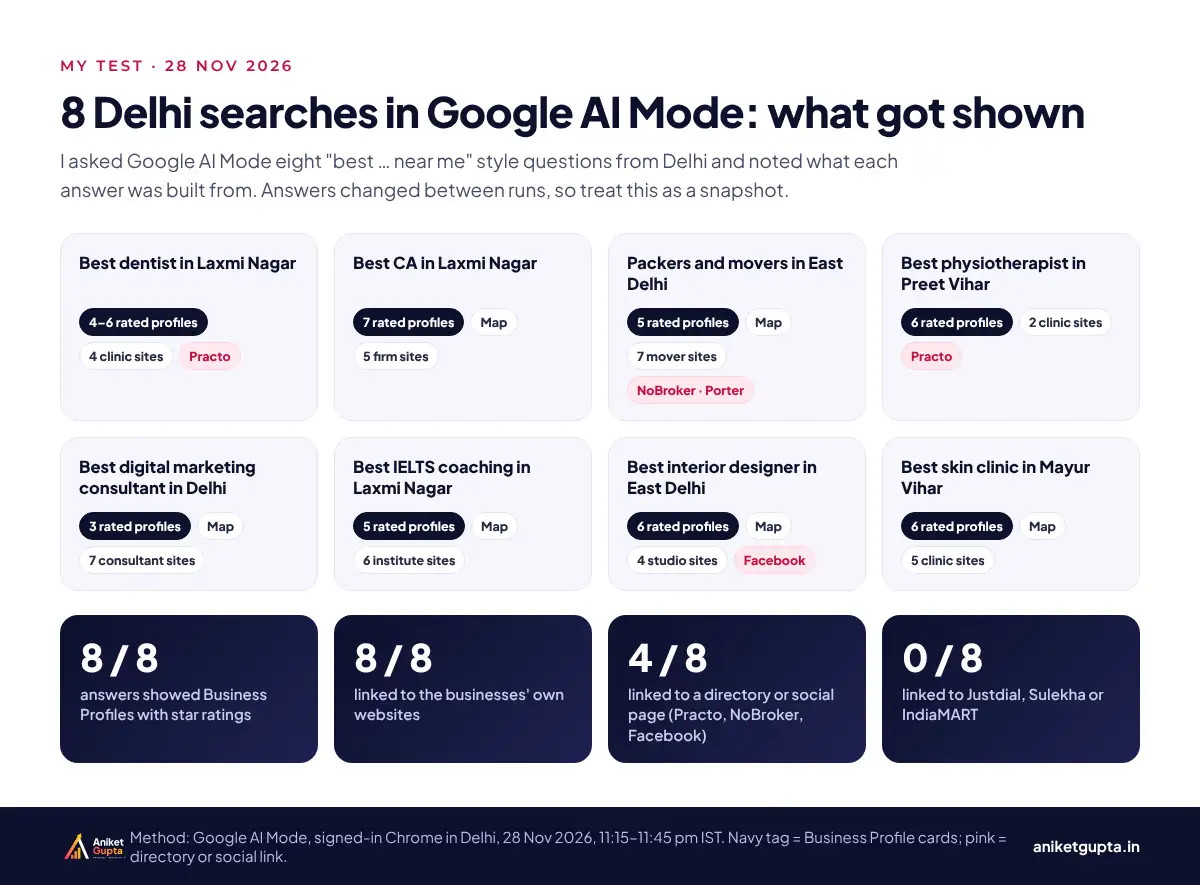
Most AI search studies use US cities. To see what happens here, on 28 November 2026 between 11:15 and 11:45 pm I asked Google AI Mode eight “best … in [area]” questions from Delhi, covering clinics, accountants, movers, coaching, interiors and marketing. For each answer I noted what it showed and what it linked to.
| Search | Rated Business Profiles shown | Map | Business websites linked | Directories or social |
|---|---|---|---|---|
| best dentist in laxmi nagar delhi | 4–6 | In one of two runs | 3–4 | Practo, Instagram |
| best chartered accountant in laxmi nagar delhi | 7 | Yes | 5 | None |
| packers and movers in east delhi | 5 | Yes | 7 | NoBroker, Porter |
| best physiotherapist in preet vihar | 6 | No | 2 | Practo |
| best digital marketing consultant in delhi | 3 | Yes | 7 | None |
| best ielts coaching in laxmi nagar | 5 | Yes | 6 | None |
| best interior designer in east delhi | 6 | Yes | 4 | |
| best skin clinic in mayur vihar | 6 | Yes | 5 | None |
What it means for a Delhi business
- Your Business Profile is the foundation. Every answer showed businesses with star ratings and review counts, and several added “highlights” drawn from reviews, such as painless treatment or opening hours. My Business Profile checklist covers what to fill in.
- Your website is the second source. All eight answers linked to the businesses’ own sites, which supplied the detail AI Mode summarised: services, specialities and prices.
- Directories mattered less than expected. Practo appeared for two health searches and NoBroker and Porter for movers. Justdial, Sulekha and IndiaMART didn’t appear once.
- Answers change. Running the dentist search twice gave a different mix of links, and only one run showed a map. Don’t judge your visibility from a single check.
- Consistency gets repeated. For “best digital marketing consultant in delhi”, AI Mode named me and summarised my local SEO, Business Profile and WhatsApp automation work. That matches what my profile and service pages say, which is the point: AI repeats what is stated clearly and consistently about you.
AI search “hacks” you can skip
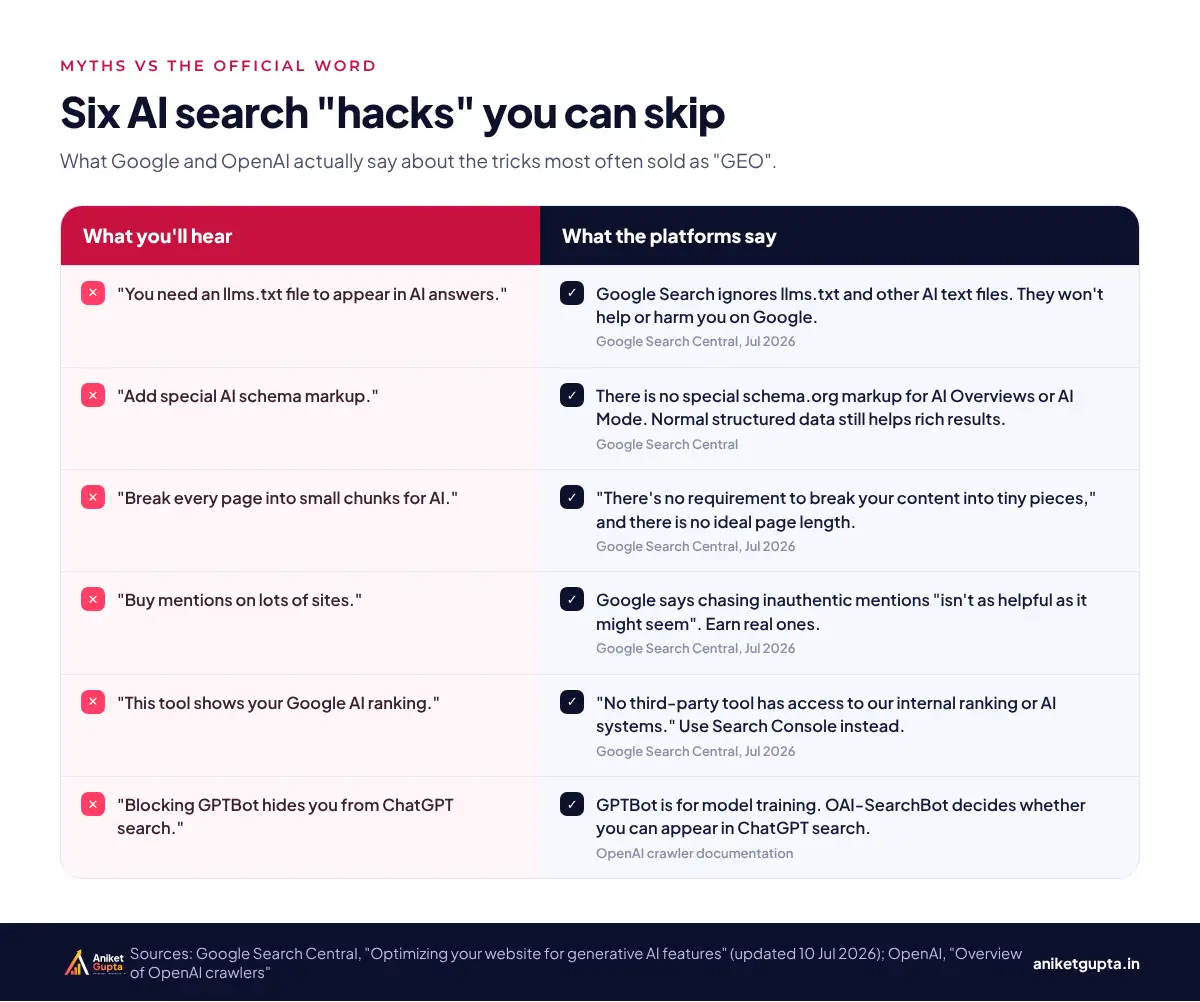
Google’s own July 2026 guide says that optimising for generative AI search “is optimizing for the search experience, and thus still SEO”. That rules out much of what’s being sold as GEO:
| What you’ll hear | What the platforms say |
|---|---|
| You need an llms.txt file | Google Search ignores llms.txt and similar AI files. They won’t help or harm you on Google |
| Add special AI schema | There’s no special schema.org markup for AI features. Normal structured data still helps rich results |
| Chop pages into small chunks | “There’s no requirement to break your content into tiny pieces,” and no ideal page length |
| Buy mentions on lots of sites | Chasing inauthentic mentions “isn’t as helpful as it might seem” |
| This tool shows your Google AI ranking | “No third-party tool has access to our internal ranking or AI systems” |
| Blocking GPTBot hides you from ChatGPT | GPTBot is for training. OAI-SearchBot controls ChatGPT search |
The checklist: 10 steps to get mentioned in AI answers
- Check Google can index and quote you. Use URL Inspection in Search Console on your main pages, and make sure none carries a nosnippet tag by mistake.
- Let the search crawlers in. Allow Googlebot, Bingbot and OAI-SearchBot in robots.txt. If you’d rather stay out of AI training, block GPTBot or use Google-Extended instead; neither removes you from search.
- Complete your Google Business Profile. Set the right primary category, services, hours, service area and photos, and link each service to its matching page.
- Ask every customer for a review. Google’s rules don’t allow asking only happy customers. Reply to every review, because AI Mode quoted review highlights in my test.
- List yourself on Bing Places. The new Bing Places for Business at bing.com/forbusiness can import your Google listing. ChatGPT and Microsoft Copilot lean on Bing data.
- Give each service its own clear page. State what it is, who it’s for, the price or price range, the areas you serve, how it works and the common questions. AI tools quote specifics, not slogans.
- Back up claims with facts and sources. In the GEO research paper (KDD 2024), adding quotations, statistics and cited sources raised visibility in AI answers by up to about 40% on the authors’ test set. Treat it as a direction, not a promise.
- Keep your name, address and phone identical everywhere: your site, Business Profile, Bing, social profiles and the directories that matter in your field, such as Practo for clinics.
- Earn real mentions. Local news, trade associations, supplier and partner pages, client case studies and genuine “best of” lists all help. Paid link packages don’t.
- Keep facts current. AI answers repeat what they find. An old price or old opening hours on one page can end up in an answer.
How to measure your AI visibility
| Tool | What it shows | Good to know |
|---|---|---|
| Search Console: generative AI performance report | Impressions from AI Overviews, AI Mode and AI features in Discover, by page, country and date | Free. Google said on 31 Aug 2026 it had reached all sites, but small sites may not see data yet. No clicks shown |
| Search Console: Performance (Web) | Clicks and impressions from all Google Search | Google counts AI Overviews and AI Mode traffic here, mixed in with normal results |
| Bing Webmaster Tools: AI Performance | How often Copilot and Bing’s AI summaries cite your pages, which pages, and the “grounding queries” used | Free; public preview since February 2026 |
| Google Analytics 4 | Visits from chatgpt.com, perplexity.ai, gemini.google.com and copilot.microsoft.com | ChatGPT tags its links utm_source=chatgpt.com. A bug briefly dropped the tag in October 2026 |
| A monthly prompt check | Whether you’re named, and how you’re described | Run the same 10 questions in AI Mode and ChatGPT each month and log the answers in a sheet |
Look beyond visits. If AI answers send fewer people to your site but more people call or message after seeing your name, track the calls and WhatsApp enquiries too. My lead-generating website guide shows how to set that up.
Should you block AI crawlers?
| Control | What it does | Effect on being found |
|---|---|---|
| Blocking Googlebot | Stops Google Search crawling | Removes you from Google Search, AI features included |
| nosnippet or max-snippet | Limits text Google can show from a page | Can keep text out of AI answers, but shrinks normal snippets too |
| Search Console’s AI opt-out setting | Excludes your site from AI Overviews, AI Mode and Discover’s AI features | Google says you lose traffic from those features; it isn’t a ranking signal elsewhere |
| Google-Extended | Limits AI training and grounding in some of Google’s other systems | No effect on Google Search |
| Blocking OAI-SearchBot | Stops ChatGPT search crawling | Keeps you out of ChatGPT search answers |
| Blocking GPTBot | Opts out of OpenAI model training | No effect on ChatGPT search |
For a business that wants customers, the sensible default is to let the search crawlers in: Googlebot, Bingbot and OAI-SearchBot. Whether to allow training crawlers is a separate choice.
A 30-day plan
- Week 1: baseline. Write down 10 questions customers ask, run them in AI Mode and ChatGPT, and log who gets named. Open Search Console’s AI report and Bing’s AI Performance report, and check robots.txt.
- Week 2: profiles. Complete your Business Profile, set up Bing Places, fix any name, address or phone mismatches, and start asking every customer for a review.
- Week 3: pages. Rewrite your three most important service pages with prices, areas, process and FAQs. Publish one useful guide that answers your customers’ most common question with real numbers.
- Week 4: mentions and re-check. Pitch two or three genuine mentions, such as an association listing or a supplier’s case study. Then run the same 10 questions again and compare.
Want to know what AI says about your business?
I run the questions your customers ask through Google AI Mode, AI Overviews and ChatGPT, check your Business Profile, Bing listing and service pages, and send a written list of fixes. The first check is free; ongoing AI search work is part of my Advanced SEO plan at ₹24,999 a month plus GST, or can be added to another plan.
Related guides and services
FAQs
How do I get my business into Google AI Overviews?
Make sure your pages are indexed and allowed to show a snippet, then do the SEO basics well: clear pages that answer real questions, a fast site and good internal links. Google says there are no extra technical requirements. For local searches, a complete Business Profile with genuine reviews matters a lot.
How do I get ChatGPT to recommend my business?
Allow OAI-SearchBot in robots.txt, list your business on Bing Places and verify your site in Bing Webmaster Tools, keep clear service pages with prices and areas, and earn genuine reviews and mentions. You can’t pay for a place in ChatGPT’s answers; ChatGPT Ads are a separate paid placement.
Do I need an llms.txt file?
Not for Google: Google Search ignores llms.txt and similar files, so it won’t help or harm you there. It’s harmless to add if another service you care about reads it.
Does schema markup help with AI Overviews?
Google says there’s no special schema for AI Overviews or AI Mode. Normal structured data is still worth having because it helps with rich results and makes your details unambiguous.
Is GEO different from SEO?
Google treats it as SEO. The difference is emphasis: consistent business details everywhere, specific facts that are easy to quote, and genuine mentions of your business on other sites.
Can I see AI Overview traffic in Search Console?
Yes, partly. The generative AI performance report shows impressions from AI Overviews, AI Mode and Discover’s AI features. Clicks from those features are counted within the normal Web performance report.
Will AI Overviews reduce my website traffic?
Informational pages are likely to lose some clicks: Pew and Ahrefs both measured large drops. Local businesses can lose fewer visits if AI answers name them, so track calls and enquiries as well as visits.
How long does it take to show up in AI answers?
There’s no fixed timeline. ChatGPT applies robots.txt changes in about 24 hours, but new pages and profile changes only count once they’re crawled again, which Google says can take days to months. Re-check your questions monthly.
Sources
- My Google AI Mode test: 8 Delhi searches, signed-in Chrome, 28 Nov 2026
- Google Search Central: AI features and your website
- Google Search Central: Optimizing your website for generative AI features on Google Search (updated 10 Jul 2026)
- Google: Q2 2026 earnings call remarks (AI Mode passes 1 billion monthly users)
- TechCrunch: ChatGPT reaches 900M weekly active users (Feb 2026)
- TechCrunch: India has 100M weekly active ChatGPT users, Sam Altman says (Feb 2026)
- Pew Research Center: Google users are less likely to click on links when an AI summary appears (Jul 2025)
- Ahrefs: AI Overviews reduce clicks by 58%
- BrightLocal: Local AI visibility study (Sep 2026)
- OpenAI: Overview of OpenAI crawlers
- OpenAI Help: Publishers and developers FAQ (utm_source=chatgpt.com)
- Search Engine Roundtable: ChatGPT UTM parameters missing, then restored (Oct 2026)
- Search Engine Journal: Search Console AI reports rolled out worldwide
- Bing Webmaster Blog: AI Performance in Bing Webmaster Tools (Feb 2026)
- Bing: Introducing the new Bing Places for Business (Oct 2025)
- Aggarwal et al.: GEO: Generative Engine Optimization (KDD 2024)