What Makes a Website Generate Leads? 10 Essentials for Small Business Websites in 2026
 Aniket Gupta
Updated November 1, 2026
7 min read
Key takeaways
- In India, 84% of web traffic comes from mobile devices (StatCounter, October 2026). Design and test for phones first.
- Google found 53% of mobile visitors leave a page that takes longer than three seconds to load. Aim for a Largest Contentful Paint of 2.5 seconds or less.
- Simple copy converts better. Unbounce found pages written at a 5th to 7th grade reading level converted at 11.1%, more than double the rate of professional-level writing.
- Give every page one clear call to action, repeated, with click-to-call and WhatsApp for mobile visitors.
- If you can’t measure enquiries, you can’t improve them. Track calls, WhatsApp clicks and forms in GA4 from day one.
In this guide
Most small business owners judge their website by how it looks. Customers judge it by how quickly it answers three questions: Is this what I need? Can I trust them? How do I get in touch? A lead-generating website answers all three on a phone screen in a few seconds.
Below are the ten essentials I build into every client website, with the research behind each one.
Why most business websites don’t bring in leads
The usual problems are slow pages, vague headlines, buttons that are hard to find on a phone and no way of knowing which page brought an enquiry. The numbers explain why these matter so much.
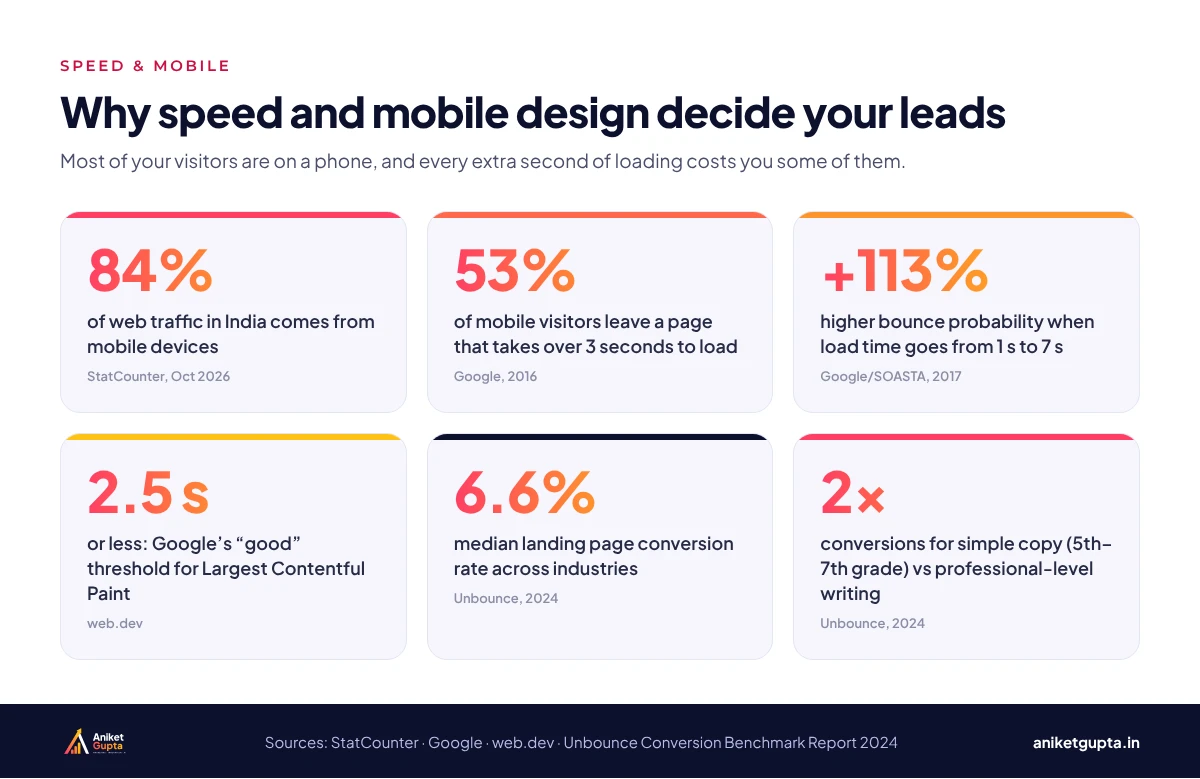
Unbounce’s 2024 benchmark report, based on more than 41,000 landing pages, found a median conversion rate of 6.6% across industries. It also found that 83% of visits were on mobile, yet desktop still converted about 8% better, a sign that many pages are not yet built well for phones.
The 10 essentials
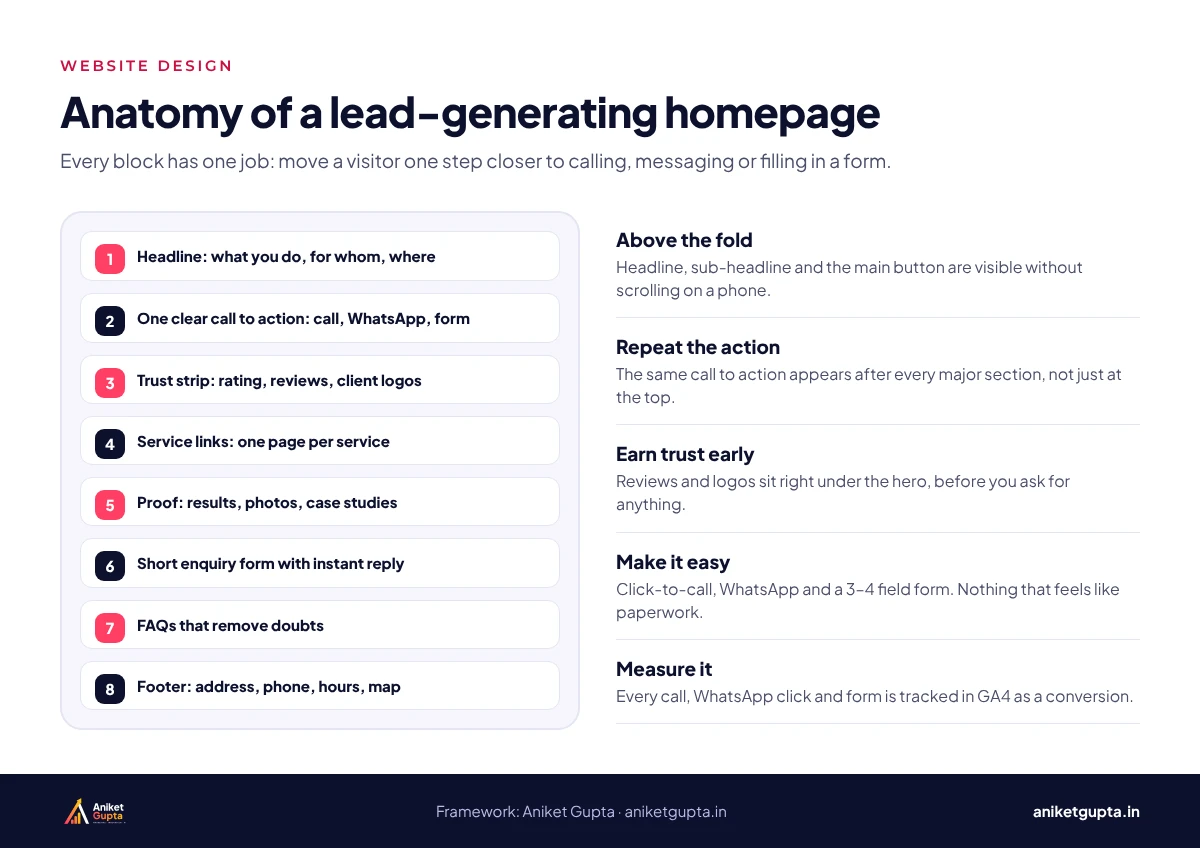
1. A headline that says what you do, for whom and where
Replace slogans with specifics. Pathology lab in Laxmi Nagar with home sample collection beats Your health, our priority. Visitors should understand your offer without scrolling.
2. One primary call to action, repeated
Decide the one action you want, whether that’s a call, a WhatsApp message or a form, and repeat the same button after each major section. Too many competing buttons lower conversions.
3. Mobile-first design
With 84% of Indian web traffic on mobile, design the phone layout first: thumb-friendly buttons, readable text without zooming and a sticky call or WhatsApp button.
4. Fast loading
Compress images (WebP), avoid heavy sliders and page builders where possible, and use good hosting with caching. Google/SOASTA research found the probability of a bounce rises by 113% as load time goes from one second to seven.
5. Simple, scannable copy
Short sentences, plain words and clear headings. Unbounce found that word count and difficult words are both negatively correlated with conversion rates, and that simpler pages convert at roughly twice the rate of professional-level writing.
6. Trust signals near the top
Show your Google rating, review count, client logos, certifications and real photos early. BrightLocal reports that 97% of consumers read reviews for local businesses, so bring the best ones onto your website.
7. A dedicated page for each service
One page per service helps visitors find exactly what they need and helps you rank. In Whitespark’s 2026 study, a dedicated page for each service is the top-rated factor for local organic rankings.
8. Short forms and instant follow-up
Ask only for what you need, usually a name, a phone number and a short message. Then reply fast: an instant WhatsApp or email acknowledgement and a call within the hour.
9. SEO built in from day one
Unique page titles and meta descriptions, one H1 per page, internal links, image alt text, schema markup, an XML sitemap and Search Console set up before launch. Fixing these later costs more.
10. Tracking that shows where enquiries come from
Set up Google Analytics 4 and Google Tag Manager to record calls, WhatsApp clicks and form submissions as conversions. Then you can see which pages, searches and ads actually produce leads.
| Essential | Why it matters | Quick check |
|---|---|---|
| Clear headline | Visitors decide in seconds | Can a stranger tell what you do in 5 seconds? |
| One call to action | Fewer choices, more action | Is the main button visible on a phone without scrolling? |
| Mobile-first | 84% of traffic in India is mobile | Is the text readable without zooming? |
| Fast loading | 53% leave after 3 seconds | Is LCP under 2.5 s in PageSpeed Insights? |
| Simple copy | Simple pages convert about 2× better | Would a 12-year-old understand it? |
| Trust signals | 97% read reviews | Is your Google rating visible near the top? |
| Service pages | Top local organic factor | Does every service have its own page? |
| Short forms | Less effort, more enquiries | Four fields or fewer? |
| SEO basics | Pages need to be found first | Unique title and H1 on every page? |
| Tracking | You can’t improve what you can’t see | Are calls and forms recorded in GA4? |
Core Web Vitals in plain English
Core Web Vitals are Google’s measures of real-user experience. A page passes when it meets the good threshold for all three at the 75th percentile of visits, on mobile and desktop separately.
| Metric | What it measures | Good threshold |
|---|---|---|
| Largest Contentful Paint (LCP) | How quickly the main content appears | 2.5 seconds or less |
| Interaction to Next Paint (INP) | How quickly the page responds to taps and clicks | 200 milliseconds or less |
| Cumulative Layout Shift (CLS) | How much the layout jumps while loading | 0.1 or less |
You can check any page for free in Google’s PageSpeed Insights. Field data, gathered from real Chrome users, matters more than the lab score.
Landing page or full website?
| Landing page | Business website | |
|---|---|---|
| Best for | One offer or ad campaign | Several services and long-term SEO |
| Pages | 1 | 5–15 |
| Main goal | Convert paid traffic | Rank, inform and convert |
| Typical timeline | 1–2 weeks | 3–5 weeks |
| My starting price | ₹8,000 | ₹20,000 |
A 10-minute self-audit
- Open your homepage on your phone. Can you see what you do and a button to contact you without scrolling?
- Run the page through PageSpeed Insights. Is LCP under 2.5 seconds?
- Tap your phone number and WhatsApp button. Do they open correctly?
- Submit your own contact form. Did you get the enquiry, and did the visitor get a confirmation?
- Check GA4. Can you see how many calls and forms came in last month, and from where?
Need a website that brings in enquiries?
I design and build fast, mobile-first WordPress and Shopify websites with SEO and tracking set up from day one. Landing pages start at ₹8,000, business websites at ₹20,000 and online stores at ₹30,000, plus GST.
FAQs
What is a good conversion rate for a small business website?
It varies by industry and traffic source. Unbounce’s 2024 benchmark found a median of 6.6% for landing pages across industries. Full websites usually convert lower because visitors arrive with different intentions, so compare against your own past numbers.
How fast should my website load?
Aim for a Largest Contentful Paint of 2.5 seconds or less for most visits, which is Google’s good threshold. Google’s research found 53% of mobile visitors leave pages that take longer than three seconds.
Do I need a website if I have a Google Business Profile and Instagram?
Yes, if you want to rank for services and control how you’re presented. Your profile and social pages bring people in; your website answers their questions, builds trust and captures the enquiry.
Which is better for small businesses, WordPress or Shopify?
WordPress suits service businesses that need flexibility and content. Shopify suits product businesses that want a store that is simple to run, with hosting and security handled for them.
How many calls to action should a page have?
One main action, repeated in several places. You can offer a secondary option, such as WhatsApp alongside a form, but avoid several competing goals on one page.
Should I put prices on my website?
Showing starting prices filters out poor-fit enquiries and builds trust. If every job is different, give a range or a starting point and explain what affects the final price.
How do I know which pages bring enquiries?
Set up Google Analytics 4 with conversion events for calls, WhatsApp clicks and form submissions, and use UTM tags on links from your Google Business Profile and ads.
How long does it take to build a lead-generating website?
A landing page usually takes one to two weeks, a business website three to five weeks and an online store four to eight weeks, depending mostly on how quickly content and feedback come in.
Sources
- StatCounter: Desktop vs mobile vs tablet market share, India
- Marketing Dive: Google, 53% of mobile users abandon sites that take over 3 seconds to load (2016)
- AMP Blog: New industry benchmarks for mobile page speed (Google/SOASTA research, 2017)
- web.dev: Web Vitals
- Unbounce: Conversion Benchmark Report 2024
- BrightLocal: Local Consumer Review Survey 2026
- Whitespark: Local Search Ranking Factors 2026